
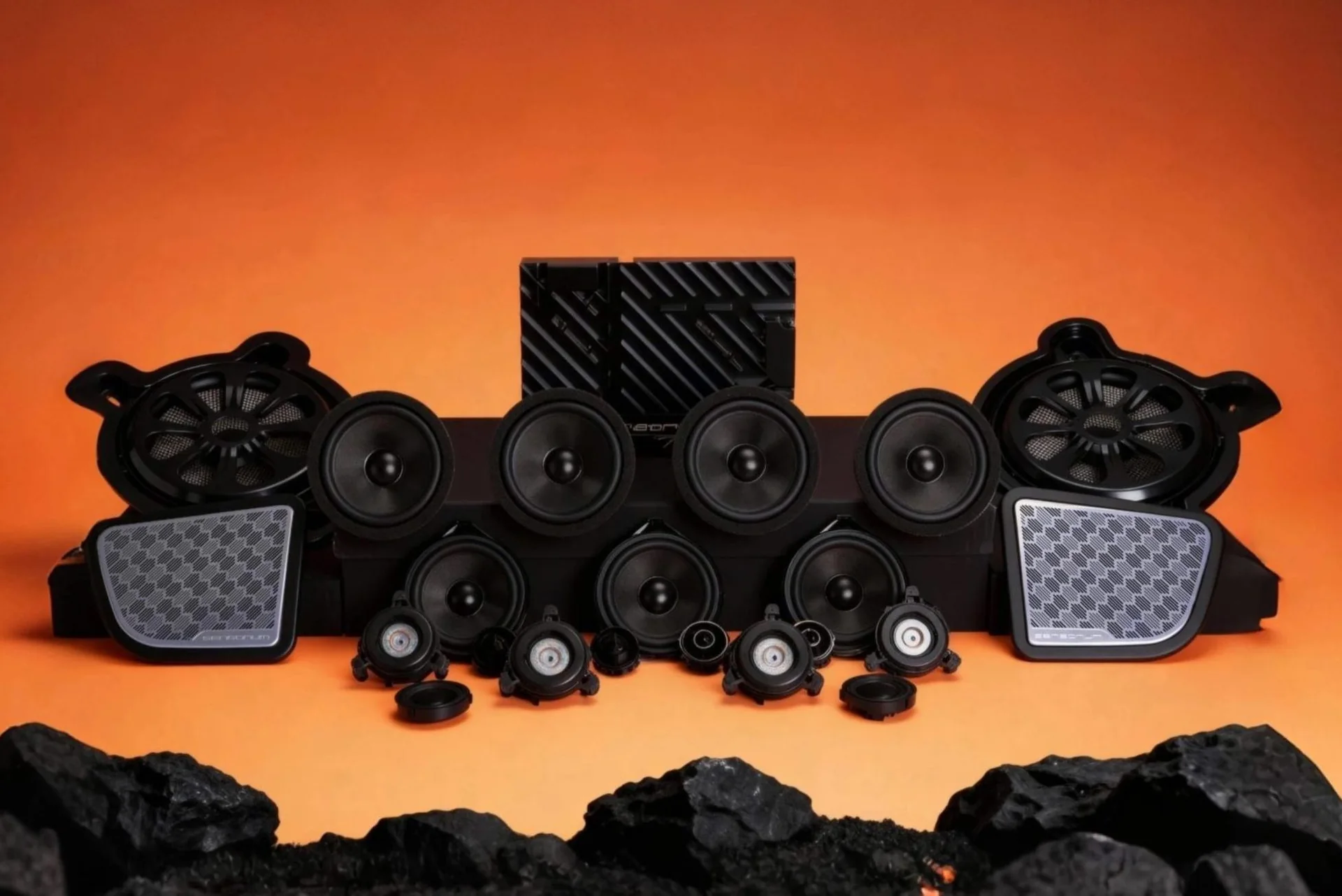
The W206 Mercedes-Benz C-Class has clearly separated factory audio tiers: seven unbranded speakers as standard, or an optional Burmester system with 15 speakers and a 710 W amplifier. Some owners did not select the option, while the installation work and programming required for a later Burmester retrofit can be a barrier. Sensonum offers a third-party system-level upgrade. This article examines its W206 hardware, sound processing and system architecture.
1. Hardware and speaker units
The W206 C-Class solution has 17 units: 13 speakers and four 4D seat-mounted haptic transducers. Compared with the W214 E-Class solution on the same platform, it omits the two rear-door tweeters.
Driver materials are selected for each frequency range.
The woofers use sandwich composite carbon-fiber cones. A damping layer sits between two carbon-fiber layers. The structure combines stiffness with low mass: carbon fiber's elastic modulus exceeds ordinary paper and polypropylene, supporting linear piston motion at large excursions and reducing distortion from cone breakup. Its physical characteristics help the cone follow transients and stop cleanly.
The midrange drivers use black woven-fiberglass cones. Fiberglass has a higher Young's modulus than ordinary pulp, and weave density can be used to control damping. Across the midrange (approximately 300 Hz to 3 kHz, a range important to vocal and instrumental clarity), a higher breakup frequency supports more uniform piston motion and clear vocal reproduction. Sensonum did not invent this material choice; other mid- and high-end automotive drivers use similar designs. Its use across every midrange position, including center and surround, is less common in aftermarket systems at this price level.
The tweeters use silk domes. Silk is a mature automotive tweeter material. Its self-damping characteristics help provide a smoother, more natural high-frequency roll-off than metal, reducing the ringing peaks associated with metal diaphragms. Ultra-high-frequency extension is lower than with beryllium or diamond, although frequencies above 20 kHz contribute relatively little to near-field listening in a cabin.
The 4D haptic transducers use composite diaphragms and sit inside the seats. They transmit low-frequency vibration through solid structures rather than air, adding a tactile channel to bass reproduction. The principle resembles the transducers used in higher-specification Mercedes-Maybach systems: tactile feedback supplements hearing at very low frequencies, approximately 20–80 Hz.
The W206 uses a 16-channel all-digital amplifier in a die-cast aluminum enclosure, with the metal's thermal conductivity and fins providing passive cooling. Its stated maximum power is 1920 W, compared with the 710 W figure for the factory W206 Burmester amplifier, a numerical ratio of approximately 2.7. Power alone does not determine sound quality; it relates to available headroom during peaks, such as orchestral tutti passages that can demand several times average power.
Inside the amplifier, an ADI SigmaDSP handles basic stereo processing and an ADI SHARC-series DSP runs the 3D surround algorithm. SHARC processors also appear in high-end automotive systems from Bowers & Wilkins, Harman Kardon and others. Sensonum's amplifier platform derives from its Lamborghini Urus OEM solution, bringing a production-validated architecture to the Mercedes-Benz application.
2. Three sound modes
Sensonum offers three selectable sound modes on the Mercedes-Benz platform, giving the user a choice of acoustic presets.
Reference Mode Aims for faithful, uncolored reproduction without additional frequency gain or reverberation. Its approach resembles studio near-field monitoring and suits instrumental solos or unaccompanied vocals where tonal accuracy matters.
HiFi Mode Builds on the Reference setting with gain and equalization across the highs, mids and lows for a fuller, comfortable sound. It provides a balanced foundation for everyday listening, from pop and rock to jazz.
SURREAL SURROUND 3D Mode The SHARC DSP runs a 3D surround algorithm that expands a two-dimensional stereo stage into an immersive space with a sense of height. Related processing is established in Bowers & Wilkins and B&O product lines. In a compact cabin, reconstructing spatial reverberation from the recording can extend the perceived width and depth. This mode suits large orchestral works and live recordings that carry substantial spatial information.
The W206 Burmester system uses a fixed tuning curve, without a choice between multiple acoustic presets. Sensonum's three modes let the user select the tuning character, providing greater flexibility.
3. Installation and system architecture
Sensonum uses matching factory-style connectors without cutting wires, modifying vehicle circuits, drilling bodywork or cutting trim. Speaker positions and angles are calibrated for the W206 cabin before delivery. Installation restores a predefined system rather than building a new tuning arrangement from scratch.
The amplifier is independent. It takes audio and 12 V power from the head unit without connecting to or reading or writing the CAN bus. It sends no data to vehicle controls and requires no Xentry programming. A later Burmester retrofit, by comparison, requires Xentry amplifier programming and head-unit recognition; incomplete programming can leave an amplifier locked or unrecognized. Sensonum's architecture removes that programming step and its associated failure risks. Similar independent-system principles are used in Tesla aftermarket audio.
After installation, automatic acoustic calibration detects speaker positions and the cabin's acoustic characteristics, then corrects the sound field. This reduces dependence on an installer's subjective tuning skills.
4. The shared technology platform
The following capabilities belong to Sensonum's shared platform rather than being exclusive to the W206.
ANC uses cabin microphones to capture environmental noise and DSP-generated opposite-phase signals to reduce it, with the stated effective range extending to 350 Hz. It targets low-frequency engine and road noise, helping music detail remain audible during highway cruising.
Speed compensation dynamically adjusts gain and loudness with vehicle speed to offset increased noise masking.
Sound-zone control allows separate settings for the driver, front passenger and rear seats.
Absolute Zero Bass is a patented subwoofer waveguide design that optimizes the acoustic path to improve bass extension and efficiency.
Quality measures include Toyota-standard 1000-hour EMC immunity testing, AEC-Q200-qualified inductors, full connector testing to Harman standards and automotive-grade temperature-resistant wiring. The stated after-sales policy is a three-year replacement-rather-than-repair warranty, insured by PICC.
5. Conclusion
The W206 solution applies OEM engineering standards to an aftermarket product. Technical Development Director Mao Fengwei founded Harman China's acoustics business, and core team members come from Harman's Chinese R&D organization. They have OEM development and delivery experience with Mercedes-Benz, BMW, Volvo, Jaguar Land Rover and other manufacturers. Sensonum's Lamborghini Urus OEM supply background provides further context for the platform's engineering origins.
The solution is particularly relevant to W206 owners who did not select Burmester, drivers seeking a comprehensive upgrade from the seven-speaker base system, and listeners who prefer choosing between tuning styles.
Sensonum's approach is to apply OEM supply standards to aftermarket development, production and quality control. The resulting hardware, architecture and reliability requirements distinguish the solution from a conventional component-by-component upgrade.