
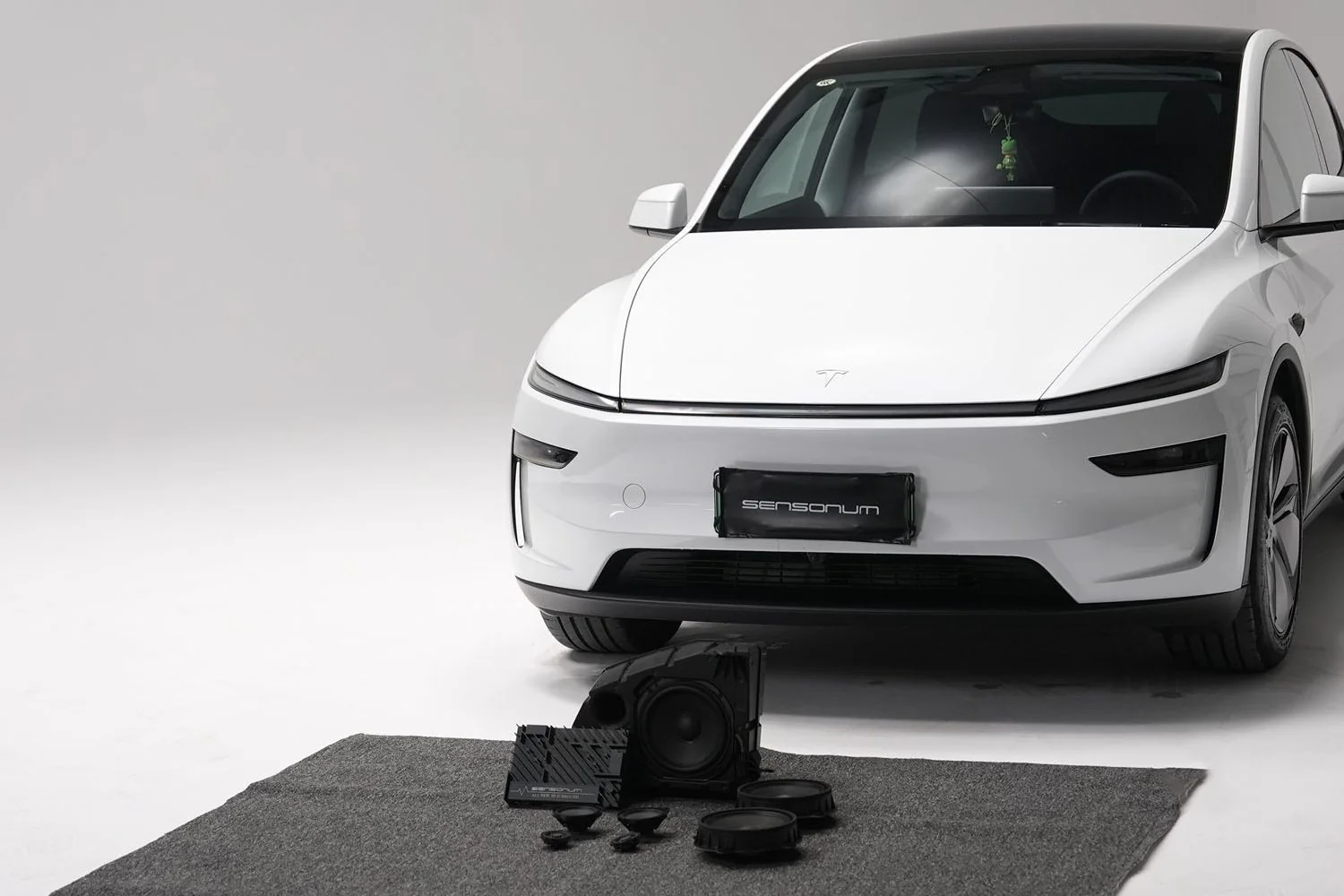
Within Sensonum's product range, the refreshed Tesla Model Y has a distinctive place. It inherits the standard capabilities of the shared Sensonum platform and adds four technologies not offered by the other vehicle solutions, including Mercedes-Benz, Porsche Macan and Audi A6L. Together, these four technologies form the Model Y version's principal distinction within the range.
The shared platform: built on OEM engineering standards
The Model Y solution uses an ADI SHARC DSP and a dedicated digital amplifier, with sound-field processing, zone controls and vehicle-specific tuning. Speaker layouts, nominal maximum amplifier power and available functions differ between vehicle kits. Features of another kit should not be assumed to be standard on this Model Y system. Hardware and software capabilities are subject to the current product details, compatible versions and confirmed delivery list.
Technology 1: AI Waveform Shaping
AI Waveform Shaping adds an enhancement layer to the shared 3D surround algorithm and is the central element of the four technologies. It performs layered spectral analysis of ordinary two-channel stereo and automatically separates it into three independent audio layers.
The first layer is direct sound: lead vocals and main melody instruments, which need clear positioning and a stable image. The second is positioned instrumental sound: drum transients, string sections and solo instruments whose locations establish width and depth. The third is ambient reverberation: natural recording-room reflections, spatial background effects and reverb tails. This layer carries the sense of space and envelopment that conventional stereo playback can compress, blur or lose.
Separation is only the first step. Sensonum's engineering team records the Model Y's acoustic parameters in advance, including body-panel resonance, absorption by interior materials, seat occlusion and cabin reflection paths. Its proprietary active spatial correction algorithm then compensates for standing waves, echoes and frequency attenuation, dynamically adjusting high- and low-frequency gain to maintain consistent listening across the front, rear, left and right seats despite the cabin's acoustic asymmetry.
The three signal layers are distributed across the upgraded system's 14-speaker layout. Ambient reverberation is routed to the surround and overhead speakers to add height to the horizontal soundstage. Conventional DSP tuning adjusts frequency response and delay; AI Waveform Shaping separates and spatially remaps the audio signal in real time.
Technology 2: Immersive Spatial Audio
AI Waveform Shaping and Immersive Spatial Audio describe the algorithm and its audible result. The first explains how the processing works; the second describes what the listener hears.
Immersive Spatial Audio is designed to benchmark the Immersive Sound X experience of higher-specification Tesla vehicles. Within the Tesla range described here, that feature is offered on Long Range All-Wheel Drive and higher variants. A rear-wheel-drive vehicle with nine factory speakers, no dedicated amplifier and no subwoofer cannot deliver the same experience through its factory hardware alone. By running AI Waveform Shaping within an independent system, Sensonum brings this benchmarked immersive experience to the aftermarket, which the brand describes as unique in that market.
The intended result is a complete 3D virtual stage. Vocals form a stable image at the center of the dashboard rather than at the doors. Drum strikes have distinct positions, strings extend across the stage, and recording-room ambience spreads through overhead and surround drivers to envelop the cabin. Fixed manual EQ adjustments cannot perform real-time separation into three audio layers or assign positions dynamically for each frame of the recording.
Technology 3: Six-Dimensional Tuning Through a Dedicated App
The Sensonum Model Y kit supports sound adjustment through a dedicated app. With compatible versions, users can tune the cabin sound from their phone without returning to an installer for each adjustment. The app provides six controls, each adjustable from −10 to +10:
Depth Focus Adjusts the apparent distance of vocals. Bringing the image forward places the singer near the dashboard; moving it back blends the voice farther into the band. Front Seat Focus and Rear Seat Focus Adjust the width of the front and rear sound fields separately. When driving alone, the image can be concentrated around the driver. With passengers, it can be widened to cover the cabin. Mix Level Controls surround intensity. Higher settings emphasize ambient reverberation and spatial atmosphere for greater immersion. Bass Enhancement Adjusts low-frequency reverberation by controlling the subwoofer channel's reverb balance, rather than simply applying a large EQ boost. Soundfield Diffusion Controls the focus or spread of the vocal image. A focused setting provides precise localization; a diffuse setting blends vocals into the wider sound field.
This audio kit for the refreshed Model Y does not include seat-mounted vibration transducers or a seat-vibration intensity control. The six audio adjustments let users continue tuning after installation, save presets for different playlists, and tailor the soundstage to their seating position and listening preferences. HiFi and surround modes can be selected directly; KTV and other additional features depend on the compatible app, hardware and software versions.
Technology 4: Remote OTA Sound Updates
Remote OTA updates are familiar in connected vehicles. Sensonum describes itself as the first brand to apply them to an aftermarket audio system. The Model Y DSP amplifier supports remotely delivered algorithm revisions, allowing the sound system to evolve beyond its factory presets.
One benefit is continued refinement: new algorithms can bring more mature tuning to the same hardware, much like a phone software update. Another is tailored sound versions. The standard version provides balanced playback across most genres; the soft version emphasizes smooth strings and reduces dynamic impact for orchestral and classical music; the dynamic version offers greater headroom and a wider stage for symphonic music and jazz. Versions are delivered to the app for download and selection, with scope for further tailored releases.
Together, these four technologies distinguish the Model Y version within Sensonum's range. The shared platform establishes the baseline for quality, reliability and acoustic performance through ADI SHARC processing, an amplifier with a nominal maximum power of 2000 W, ANC, automotive-grade components and an independent plug-and-play architecture. AI Waveform Shaping, Immersive Spatial Audio, six-dimensional app tuning and remote OTA sound updates provide the Model Y's additional capabilities.
Within Tesla's closed electronic architecture, Sensonum uses an independent system to provide three capabilities it describes as unique in the aftermarket: AI-driven real-time separation and spatial remapping, six-dimensional tuning controlled by the user, and remotely updatable sound algorithms.
The development background helps explain this approach. Technical Development Director Mao Fengwei founded Harman China's acoustics business and formerly served as Technical Director of its R&D center. With nearly twenty years in automotive electronics, he has overseen OEM audio deliveries for Mercedes-Benz, BMW, Volvo, Jaguar Land Rover and other manufacturers. Sensonum is also a Lamborghini OEM audio supplier, with its system offered as a factory option on the current Urus described here. The brand uses OEM development standards to define its products, and the Model Y's four technologies were developed within that framework.